Equal Signal: A Scored Audit of Hybrid Meeting Rooms for UK Teams
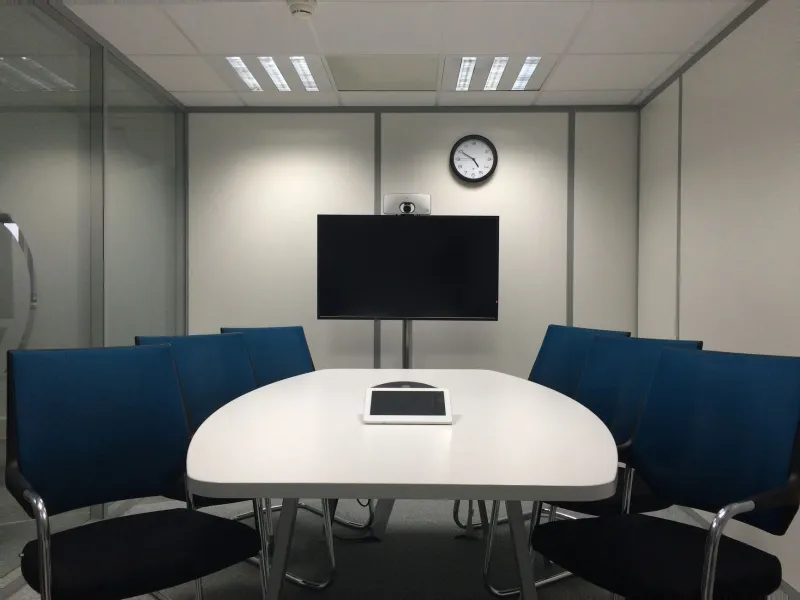
Hybrid meeting equity is often treated as a procurement problem. A room lacks a ceiling microphone, so one is bought. A camera points at the whiteboard rather than the people, so a replacement is ordered. The result can be a well-equipped room that still fails the person dialling in from Leeds, Manchester or a home office in Cardiff. The question is not whether the room has technology. It is whether the remote participant receives the same meeting as the people sitting in it.
A room can be full of people and still be unable to hear the person who is not in it. That is the gap this audit addresses. It is deliberately low-tech: a scorecard, a stopwatch, a remote observer and a booking export. The aim is to find the rooms where hybrid meetings are quietly unequal, fix the cheap problems first, and build a cost case for anything that remains.
Equity is not the same as equipment
Equality gives every room the same kit. Equity asks whether the remote participant can hear, see, be seen, be identified when speaking, read shared content and join without a ritual. Those are different tests. A room can pass an equipment checklist and fail every one of them.
For UK teams, the practical standard is simple: a remote attendee should not have to ask the room to repeat itself, should not be looking at a row of backs, should not be handed a blurred screen share, and should not wait while someone hunts for an HDMI cable. If those things happen routinely, the room is not hybrid. It is a local room with a dial-in number.
Five dimensions, one score
Use the same five dimensions for every room. Score each from 0 to 4, where 0 means the dimension fails in normal use and 4 means it works without prompting. Apply the weights below to produce a score out of 100. The weights reflect impact on the remote participant, not the cost of the kit.
| Dimension | What good looks like | Weight |
|---|---|---|
| Microphone coverage | A person at the far end of the table can be heard clearly without leaning in; no drop-outs when two people speak; no air-conditioning roar | 30 |
| Camera framing | The remote viewer sees faces, not ceiling tiles; the speaker is visible; the frame covers the seats actually used | 20 |
| Display legibility | Shared content is readable on a laptop screen at normal size; contrast is adequate; no cropping | 20 |
| Captioning | Live captions are available, enabled and accurate enough to follow names and numbers | 15 |
| Join-time friction | A remote participant reaches clear audio and video within 60 seconds of the scheduled start | 15 |
Calculate the weighted score as (raw score ÷ 4) × weight for each dimension, then add the five results. A room below 70 is not fit for routine hybrid meetings. A room between 70 and 84 is usable but needs a fix list. A room at 85 or above can be treated as a hybrid-standard room.
The score is not a substitute for judgement. A room used once a quarter for a five-person update may not need the same standard as a room used daily for client calls. But the score makes the trade-off visible.
Run the audit without a consultant
Pick six to ten rooms, not every room in the estate. Choose the rooms that appear most often in hybrid invitations, plus one room that is heavily booked but rarely has remote attendees. Observe three meetings in each room over two to three weeks. Do not announce the audit in advance; the point is to see normal behaviour, not a demonstration.
Use a remote observer on the call. That person completes the scorecard from the remote perspective and captures screenshots of the shared content and the room view. Use a stopwatch for join time. Note the meeting type, the number of people in the room, the number remote and whether the meeting started on time.
The most common findings are mundane. Microphones are placed too far from the seats people actually use. Cameras are fixed on the head of the table rather than the wider group. Displays show a shared screen at a resolution that is fine in the room and unreadable remotely. Captions are available but switched off because nobody owns the setting. Join time is lost to a cable, a misplaced remote control or a room account that has signed out.
Cross-reference bookings with reality
Booking data is the second half of the audit. Export 90 days of room bookings from Outlook, Google Calendar or the room-booking platform. If occupancy sensors exist, use them; if not, use meeting invitations, join logs and a manual spot check. The aim is to compare what the room was booked for with what actually happened.
Look for three patterns. First, rooms with high booking volume and high remote participation but low scores: these are the priority fixes. Second, rooms with high booking volume and almost no remote participation: these may be local-only rooms and should be labelled as such, rather than blocking hybrid meetings that need better space. Third, bookings that are held and released within a short window, or meetings that move to an ad hoc call because the room cannot support the hybrid discussion: these are abandoned bookings, and they carry a cost even when no invoice arrives.
A simple room-level view is enough: room name, bookings per month, share of bookings with remote attendees, average score and number of abandoned bookings. That table will usually show that a small number of rooms create most of the inequity.
The 30-day fix list
Days 1 to 7: check the basics in every audited room. Label the correct cable. Set the default microphone and speaker. Put a one-page join guide on the table. Confirm the room account is signed in. Test the room from a remote device, not from inside the room.
Days 8 to 14: fix camera framing and display settings. Set camera presets for the common seating layouts. Increase shared-content font size where possible. Enable live captions by default for meetings where the platform allows it. Check that the remote view is not cropping the presentation.
Days 15 to 21: retest the rooms and publish the scores. Add the score to the room-booking entry so people know what they are booking. Rename or label local-only rooms. Move recurring hybrid meetings out of rooms that score below 70.
Days 22 to 30: build a short procurement case only for rooms where the score remains below threshold after the cheap fixes. Prioritise microphone coverage and camera framing; these are the dimensions that most often separate a fair meeting from a frustrating one. Avoid buying new kit for a room that is simply booked for the wrong kind of meeting.
Building the cost case
A cost case does not need precise attribution. It needs a defensible model that uses the organisation's own numbers. Consider an illustrative UK office with 12 bookable meeting rooms and 300 hybrid meetings a month. If one in five meetings loses eight minutes to a remote participant asking for repetition, a failed screen share or a late dial-in, the loss is 300 × 0.2 × 8 = 480 minutes, or eight hours a month. At a loaded cost of £55 an hour, that is £440 a month, or £5,280 a year.
Add abandoned bookings. If 40 room-hours a month are held and then released because the room cannot support the call, and the internal room charge is £15 an hour, the annual figure is £7,200. The combined case is about £12,500 a year before counting repeat meetings — the second meeting called because a decision could not be made when a remote colleague was not heard. Those meetings are rarely logged as a technology cost, but they are one.
The figure is not the point. The point is that the fix list can be ranked against it. A £400 microphone repositioning and a £0 captioning setting may recover more meeting quality than a room refresh. The audit tells you where to spend and where not to.
Make the score an operating standard
Hybrid equity improves when it becomes a booking rule rather than a goodwill gesture. Publish the scores. Label the rooms. Put hybrid-standard rooms in the default booking list for meetings with remote attendees. Review the scores every quarter, because rooms drift: furniture moves, cables disappear, accounts expire. The room that cannot hear you is rarely a mystery. It is usually a room that nobody has listened to from the other end.